
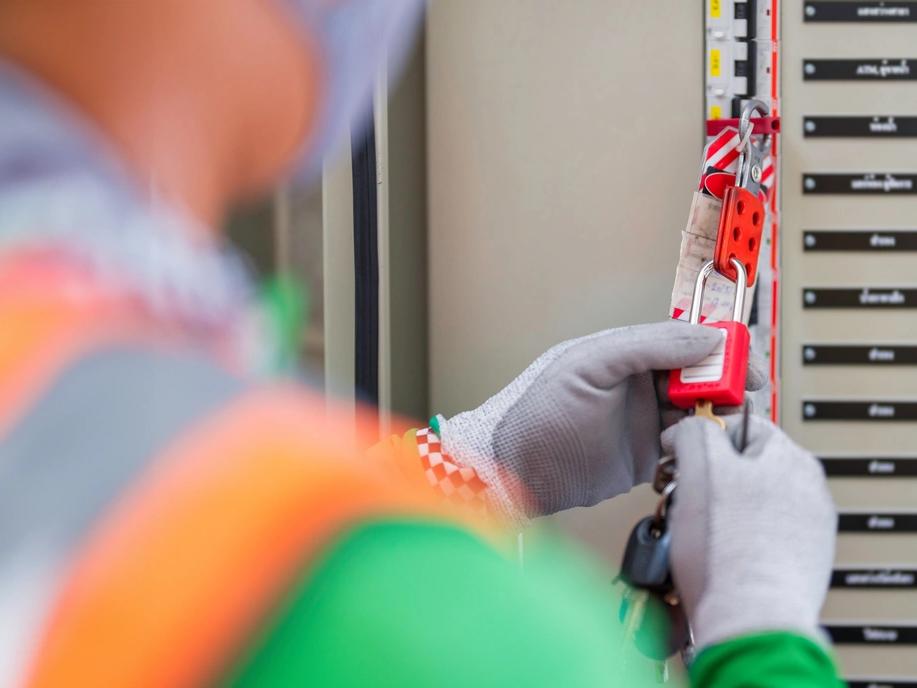
Energy Isolation (Lock Out Tag Out)
Energy sources in the workplace need to be controlled and often isolated to safely access machinery or any mechanised system. Incidents occur when there’s a lack of isolation systems and a lack of knowledge about hazards associated with plant and equipment.
- Duration
- 1/2 day
- Topic
- Safety Process
- Next session
- 23 Nov 2026 · 14 dates
At a glance
Course details
Duration:1/2 day
Unit Standard:
| Unit # | Name | Level | Credits |
|---|---|---|---|
| 25043 | Lockout and reinstate machinery in the workplace | 3 | 4 |
Overview
Energy Isolation (Lock Out Tag Out) course overview
Curriculum
What you'll cover
- Workers carrying out operational or maintenance duties on plant, machinery, or equipment.
- Team leaders and supervisors responsible for ensuring safe energy isolation and reinstatement procedures are followed.
- People responsible for isolating hazardous energy before servicing, repair, cleaning, or inspection work.
- Workplaces wanting stronger and more consistent lockout/tagout practices as part of day-to-day risk control.
Our approach
+IMPAC's Energy Isolation (Lock Out Tag Out) training approach
This Energy Isolation training is built around the points where isolation work can break down in real workplaces: assumptions about shutdowns, incomplete isolation, weak handovers, and restarting plant before the job is properly cleared. Learners work through practical scenarios and activities that help them identify hazardous energy sources, understand isolation responsibilities, apply lockout and tagout steps, and verify a zero-energy state before work begins.
The session stays focused on what people need to do on the job. Rather than relying on theory alone, facilitators connect the training to plant access, maintenance activity, and safe reinstatement so learners can see how energy isolation decisions affect the wider job. The emphasis stays on applying isolation procedures consistently, communicating clearly during handovers, and confirming equipment is safe before work starts or plant is returned to service.
Format
Course format and duration
This course is delivered over half a day.
Training is available in person nationwide for in-house delivery, with public courses offered in Auckland, Christchurch, and Hamilton, or as a pre-recorded webinar.
Upcoming sessions
Public courses – Book now
eLearning
Complete online at your own pace.
$170.00 excl. GST
Want to discuss running Energy Isolation (Lock Out Tag Out) at your organisation?
Enquire nowFAQ
Frequently asked questions
This course is suited to workers, maintenance personnel, and supervisors who may need to isolate machinery or protect themselves from hazardous energy. It is especially relevant where people service, clean, inspect, repair, or access plant that could release electrical, mechanical, hydraulic, pneumatic, thermal, or other stored energy. It also supports teams working within permit to work and maintenance control systems.
Workers isolating or working on plant with hazardous energy need the appropriate training, instruction, and supervision to carry out that work safely. While legislation does not prescribe a single lock out tag out course, workplaces must ensure hazardous energy risks are properly controlled. Many sites and clients also require workers involved in isolation activities to understand lockout, tagout, and reinstatement procedures before work begins.
Learners need written and spoken English equivalent to NCEA Level 1 (Year 11) or an IELTS score of 5.5 or higher. No separate technical qualification is required before attending. Learners do need to be able to follow isolation procedures and understand the safe sequence for energy isolation and reinstatement.
Yes. This course is available through eLearning as well as public and in-house training. This gives organisations flexibility depending on whether learners need self-paced online learning, a scheduled public course, or workplace-based team training.
The course runs for half a day, allowing time to cover energy isolation principles, lock out tag out procedures, and practical workplace controls.
Yes, this course includes one assessment covering lockout procedures, isolation responsibilities, tag out devices, reinstatement processes, and the safe application of energy isolation controls in the workplace.
Learners who successfully complete the assessment are awarded NZQA Unit Standard 25043, which covers lockout and reinstatement procedures used to safely isolate hazardous energy in the workplace.
Learners cover the practical requirements of lock out tag out training, including identifying hazardous energy, understanding isolation and reinstatement procedures, using lockout devices, and carrying out safe isolation on plant or equipment. The course also covers responsibilities, verification steps, and how to confirm systems are safe before work starts and before plant is brought back online.
IMPAC recommends refresher training at least every two years to help workers maintain safe isolation practices, reinforce correct lockout and tagout procedures, and reduce the risk of procedural drift over time. Some workplaces or high-risk environments may require more frequent refresher training depending on plant changes, site requirements, or operational risks.
Yes, this course is available for in-house delivery nationwide. In-house training can help organisations train workers using the same isolation procedures, equipment, and site controls used in their workplace.
Please bring the following to training:
- Closed footwear
- A driver’s licence or another form of photo identification
For public face-to-face courses, tea and coffee are available throughout the day. Catering is not included.
If you are completing an online or eLearning course with IMPAC for the first time, you will receive your LMS login details within 24 hours of receiving your course instructions email.
You can access IMPAC’s LMS by clicking here.
If you are completing an online or eLearning course with IMPAC for the first time, you will receive your LMS login details within 24 hours of receiving your course instructions email.
Pricing depends on the delivery method.
In-house: $2000 + GST for up to 14 persons.
eLearning: $170 + GST per person.
Continue learning
Further study options
If you’re continuing your learning journey in health and safety, this course can contribute towards IMPAC’s Certificate in Applied Workplace Health and Safety Practices (Level 3), which leads to the New Zealand Certificate in Workplace Health and Safety Practice (Level 3).
This course is a elective module within the programme, allowing you to build on your existing training while working towards a recognised qualification over time. To learn more, click here, or to enrol, click here.
This programme is approved by the New Zealand Qualifications Authority under section 439 of the Education and Training Act 2020, and Impac Services Limited is accredited to provide it under section 441 of the Education and Training Act.
What's next
Next steps
More courses
You might also like

Permit Issuer
This course provides comprehensive training of Permit Issuer protocols and procedures.

Permit Receiver
This course provides comprehensive training of Permit Receiver protocols and procedures.

Job Safety Analysis
Job Safety Analysis involves looking at a task and considering the safest way to complete it. This course helps learners become aware of the hazards involved in doing a job and act to prevent injury.